

Kin N.O., Velmovskiy P.V. The Current State and Representativeness of the Main Forest Types in the Buzuluksky Pine Forest under the Influence of Forest Crops // Ecosystems: ecology and dynamics. No 3. 2026. P. 94-122. | Abstract | PDF | Reference
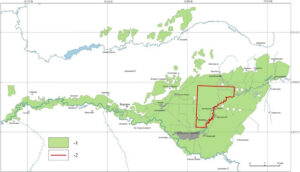
Schematic map of the study area. Legend: 1 – area of the Buzuluksky Bor National Park, 2 – boundaries of the Borovoye-Opytnoye Forestry research area
“Buzuluksky Bor” is an island pine forest that, like many other forests, is experiencing anthropogenic impact, the most common types of which are wild fires and logging, which create treeless areas. In the late 19th and early 20th centuries, there was already a need to restore and increase forest areas by creating forest crops (plantations). To achieve that, the soil and vegetation covers were significantly transformed. Seedlings of one or two breeds of the same age were used as crops, which caused issues with their development. Currently, 30% of the forested area in the “Buzuluksky Bor” has been transformed by plantations. The goal of our research is to conduct floristic studies to determine the current state and degree of preservation of the typical landscape and floristic complexes in the Buzuluksky pine forest under the influence of forest crops. The research took place in 2021-2025 and covered the Borovskoye-Opytnoye Forestry. The following types of forests are represented: mossy, false-grass, complex forests, oak forests, and softwood. The unit of area is a forest section corresponding to a specific forest type. A total of 168 floristic descriptions were conducted, including 120 descriptions of natural vegetation and 48 descriptions of planted forests. The species were classified according to their layers: tree, shrub-undergrowth, and herb-dwarf shrub. The Jaccard coefficient was used to establish the similarity between the flora of the natural and planted forests. The data were processed using standard non-parametric methods in the Statistica 10.
Planted forests increase phytodiversity, especially in the herb-dwarf shrub layer, as new ecological niches are formed allowing the introduction of species that were previously not found in natural forests. These species have a different ecological range, are numerous and frequently encountered. In this case, the increase in species diversity reflects a trend towards homogenization of the floristic composition of plant communities within different forest types.
When forming the tree layer, we used Pinus sylvestris and, to a lesser extent, Betula pendula. If other species were also present in the natural forest, the layer would become lacking in diversity. The same is accurate for the shrub-undergrowth layer; the structure changes, and this layer may become completely absent or present only in single individuals or isolated groups. The species diversity decreases or changes when the alien species are introduced to the layer.
Planted forests transform the natural landscape and its biological capacity, and have different ecological factors that are shifted towards less moisture availability and better illumination. Forests that are planted in place of certain forest types cannot be equated to them. Forest types that have been transformed by more than a quarter of plantations lose their structure and floristic originality.
Keywords: flora, forest types, plantings percentage, plant layers, homogenization, the biological volume of the landscape.
DOI: 10.24412/2542-2006-2026-3-94-122
EDN: XMWWLC