
Podolsky S.A., Levik L.Yu., Pavlova K.P., Chemirskaya D.S., Chervova L.V. Population Indices and Fauna Composition of Small Mammals in the Zeya Nature Reserve and Its Adjacent Territories under the Influence of Nature and Hydraulic Construction // Ecosystems: ecology and dynamics. No 2. 2025. P. 105-130. | Abstract | PDF | Reference
-

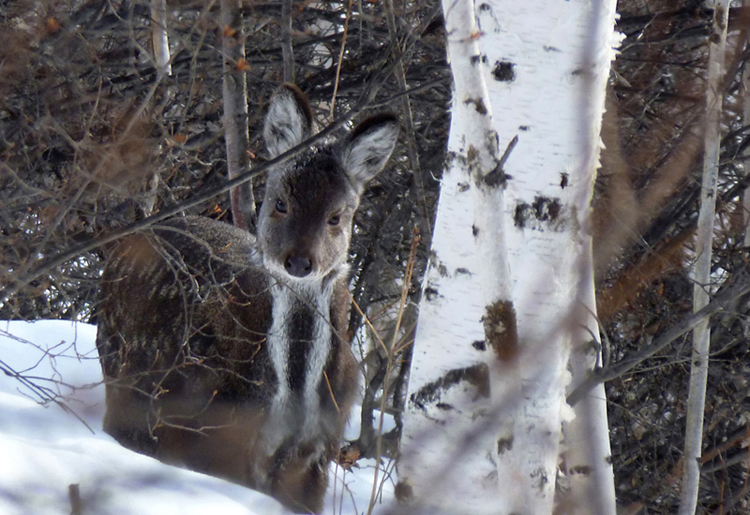
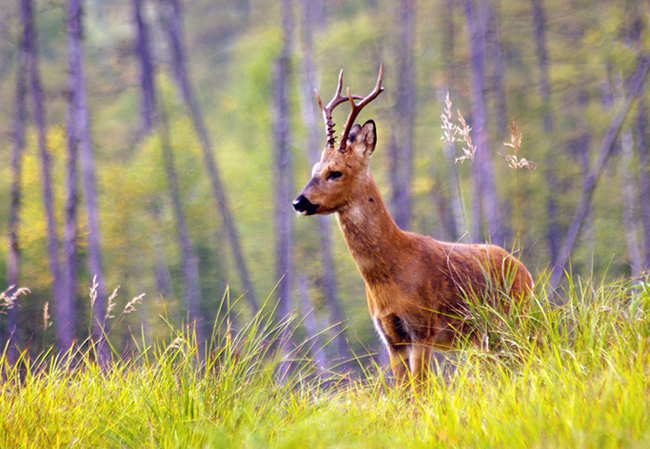
- Roe deer at the ford on the Nora River (photo by S.A.Podolsky) 2. Swimming fawns of roe deer (photo by S.A.Podolsky)

-

- Swimming fawns of roe deer (photo by S.A.Podolsky)

-

- Lenok, or Asiatic trout (photo by S.A.Podolsky)

-

- Oriental stork (photo by S.A.Podolsky)

-

- Red-crownedcranes (photo by S.A.Podolsky)

-

- Hooded crane taking off (photo by S.A.Podolsky)

-

- Hooded cranes (photo by S.A.Podolsky)

-

- A hut flooded by the Bureya water reservoir (photo by S.A.Podolsky)

The construction of large water reservoirs in the Amur Region causes numerous negative environmental consequences, changing the boundaries of species’ ranges, as well as reducing the species diversity in zoocomplexes and the number of many animal species. In addition, populations and communities under the influence of reservoirs continue to experience fluctuations due to natural processes. A reliable group of indicators for studying the impact of hydroelectric construction on terrestrial animals are small mammals, such as Rodentia and Eulipotyphla, most of which undergo frequent generational changes and, therefore, have a quick response to changes in their habitats.
In this article, we consider the main natural factors influencing the dynamics of the number of Rodentia and Eulipotyphla in the Zeya Nature Reserve, as well as changes in the abundance and fauna composition of small mammal communities on the shores of the Zeya Water Reservoir and in the influence zone of the Lower Zeya Hydroelectric Complex which is currently under construction. In the reserve and on the reservoir shores, we discovered 16 Rodentia species and 6 Eulipotyphla species. The dynamics of Rodentia number was studied on the basis of data obtained in 1982-2024, namely, from the censuses conducted on 27 trap-lines, with a total volume of about 48.5 thousand spring-loaded bar trap-days. The dynamics of Eulipotyphla was studied on the basis of data from 2003-2024, i.e., the censuses conducted on 8 trap-lines, with a total volume of about 22.9 thousand pitfall trap-days. In the reserve, we picked a zone on the mountainous shores for experimental observations, and another one that included low mountains outside the shores for background observations,
The main impact factors of the hydroelectric construction on the marginal and rare species of small mammals in the upper pool of the Zeya Reservoir are the flooding of valley habitats and the isolation of small groups of animals in the remaining habitats in the estuary areas of the valleys of the reservoir’s tributaries. Due to that the fauna of Rodentia and Eulipotyphla is already significantly depleted on the shores. The following species have disappeared from the area almost entirely: long-tailed ground squirrel (Urocitellus undulatus Pallas, 1779), reed vole (Alexandromys fortis Buchner, 1889), Amur lemming (Lemmus lemmus amurensis Vinogradov, 1924), slender shrew (Sorex gracillimus Thomas, 1907), Eurasian least shrew (Sorex minutissimus Zimmermann, 1780). Meanwhile, such species as the Maximowicz’s vole (Alexandromys maximowiczii Schrenk, 1859), tundra vole (Alexandromys oeconomus Pallas, 1776), striped field mouse (Apodemus agrarius Pallas, 1771), harvest mouse (Micromys minutus Pallas, 1771), flat-skulled shrew (Sorex roboratus Hollister, 1913), and Siberian large-toothed shrew (Sorex daphaenodon Thomas, 1907) changed their “common” or “numerous” status to “very rare”. Similar changes should be expected to occur on the shores of the Nizhne-Zeyskoye Reservoir, which is currently under construction.
The most significant influence factor of a large reservoir on the background species, such as the northern red-backed vole (Myodes rutilus Pallas, 1779), grey red-backed vole (Craseomys rufocanus Sundevall, 1846), and Laxmann’s shrew (Sorex caecutiens Laxmann, 1788), is its climate impact on the biotopes of the shores. It occurs at the same time with the natural number fluctuations of small mammals associated with the main abiotic natural factors, e.g., solar activity, precipitation and temperatures during the period of most active reproduction and the beginning of vegetation (May-June), as well as with the depth of snow cover. Both Rodentia and Eulipotyphla have an inverse correlation between the population dynamic and the amount of precipitation in May-June, as well as a direct correlation between the population dynamic and average temperatures in May-June. At the same time, for the influence zone of the Zeya Reservoir, a close and direct connection has been established between long-term changes in solar activity and precipitation in May-June.
Aside from short 3-4-year fluctuations, Rodentia species go through a long, almost 30-year-long cycle, occurring in an antiphase with similar fluctuations of the Wolf number curve; the population dynamic of Eulipotyphla is in an antiphase with 10-11-year-long cycles of solar activity.
The coasts of the Zeya Reservoir, we have discovered the deepest depressions and maximum amplitudes of population fluctuations both for Rodentia and Eulipotyphla. Moreover, shores such as these tend to become a zone of low abundance of small mammals. In Zeya, average annual losses compared to the background indicators are 8.7-16.2% for Rodentia, and 22.1% for Eulipotyphla. This causes deterioration in the food supply of many birds of prey and Mustelidae that feed on small mammals.
We have established that hydroelectric construction in the north of the Amur Region significantly reduces the species abundance and productivity of small mammal communities, which entails further losses in biodiversity. Due to both natural and anthropogenic factors, the coasts of large manmade water reservoirs turn into zones of reduced abundance of Rodentia and Eulipotyphla.
Acknowledgements. We are grateful to the management of the Zeya Nature Reserve for their help with organization and research.
Funding. This work was carried out for the Water Problems Institute of the Russian Academy of Sciences, theme No. FMWZ-2025-0002 “Researching the Formation Processes of the Surface and Ground Waters Quality, Natural and Anthropogenic Mechanisms of Ecological Changes in the Water Bodies, Development of Methods and Technologies for Managing Water Resources and Water Quality”, theme No. 1-22-37-1 of the Zeya Nature Reserve “Dynamics of Phenomena and Processes in the Ecosystems of the Zeya Nature Reserve and the Tokinsko-Stanovoy National Park”, state task No. 121051100137-4 of the Lomonosov Moscow State University (MSU) “Spatio-temporal Organization of Ecosystems under Environmental Change”; additionally, it was supported by the Development Program of the Interdisciplinary Scientific and Educational School of MSU “Future of the Planet and Global Environmental Change” and the Development Program of MSU (P. 1220).
Keywords: Rodentia, Eulipotyphla, fauna composition, population dynamic, influence zone of water reservoir, solar activity, precipitation, air temperature.
DOI: 10.24412/2542-2006-2025-2-104-129
EDN: YUUIHG